
Fishing Club 2 by BGaming Strategies: RTP Analysis & Winning Tips
Data-driven strategies for Fishing Club 2 by BGaming based on mathematical analysis of the 97.16% RTP, five risk levels, and fish multiplier distributions. Optimize your bankroll and betting approach.
Use this strategy page as a planning tool rather than a promise of results. Start by separating what the rules guarantee from what only changes your risk profile: stake size, cash-out target, session length, bonus terms and the pace of play. That distinction matters because a lower target or slower session can make decisions easier, but it does not remove the house edge or make a volatile round safe.
A practical strategy should feel repeatable under pressure. Before real play, test one idea in demo, keep the same stake for a short run, and notice where you feel tempted to break the plan. If a bonus is involved, check wagering terms before you adjust bet size or session length.
With that routine, the page becomes a calm checklist: clear limits, patient pacing, and fewer impulsive choices. The aim is not to outsmart randomness; it is to keep the session readable enough that you can stop on time.
Practical strategy notes
Before you play Fishing Club 2, use this page to slow the session down. Look first at risk levels, fishing bonus volatility and RTP math. These are the parts of the game that usually make a balance move faster, so choose your stake and stop point before the first round or spin. A small plan is easier to follow than a complicated system, especially after a quick win or a frustrating loss.
A useful warm-up is simple: compare base-bet play with bonus-trigger sessions before changing stakes. Keep the same stake during the test, then write down the starting balance, ending balance and whether you stopped where you planned. That short note tells you more than a lucky result because it shows whether the plan was realistic while the game was moving.
If you play with a bonus, read the wagering rules, max bet, expiry date and withdrawal limits before changing anything. The best strategy is usually the one that keeps decisions calm: clear limits, fewer rushed clicks and no attempt to win back a result that has already happened.
Fishing Club 2 by BGaming: RTP Mathematical Analysis
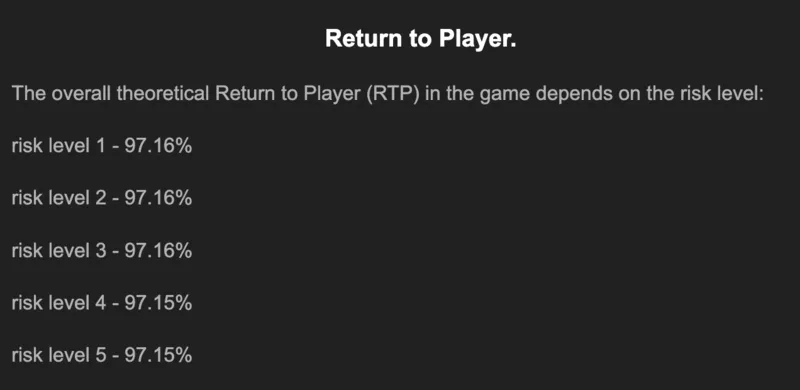
Return to Player (RTP) is the single most important metric for evaluating any casino game strategy. Fishing Club 2 operates at 97.16% RTP, according to BGaming's current official game page. These are not marketing claims from an affiliate page — they are the provider-published values players should verify against the in-game information panel.
To understand what this number means in practical terms, consider the house edge. The house edge is simply 100% minus the RTP. For Fishing Club 2 by BGaming, the official house edge is 2.84%. Compare this to the industry average house edge of approximately 4% (96% RTP), and you begin to see why Fishing Club 2 is strategically attractive.
What 97.16% RTP Means for Your Sessions
Fishing Club 2's RTP operates as a long-term statistical average. Over millions of casts, Fishing Club 2 returns 97.16 cents of every dollar wagered. In a single session of 50 to 200 casts, your actual return can deviate significantly from this figure. This deviation is called variance, and it explains why strategy matters in Fishing Club 2 even though individual outcomes are random.
Here is a concrete example. If you play 100 casts at 1 EUR per cast, you wager 100 EUR total. At 97.16% RTP, the expected return is 97.16 EUR — a theoretical loss of 2.84 EUR. But in practice, your actual results might range anywhere from 60 EUR to 150 EUR or more, depending on whether you hit high-multiplier fish. The RTP tells you the center of that distribution; variance tells you how wide it spreads.
The strategic implication is straightforward: the higher the RTP, the slower your bankroll erodes during cold streaks. A game with 95% RTP costs you 5 EUR per 100 wagered, while Fishing Club 2 costs only 2.84 EUR. Over a session of 200 casts, that difference compounds — you get significantly more casts before depleting a fixed bankroll, which means more opportunities to land a high-value catch.
House Edge Comparison Table
| Game / Risk Level | RTP | House Edge | Expected Loss per 100 EUR Wagered |
|---|---|---|---|
| Fishing Club 2 (all risk levels) | 97.16% | 2.84% | 2.84 EUR |
| Industry Average Slot | 96.00% | 4.00% | 4.00 EUR |
| Low-RTP Slot | 94.00% | 6.00% | 6.00 EUR |
As the table shows, Fishing Club 2 by BGaming costs you roughly 30% less per session compared to an average slot. Over hundreds of casts, this translates into a materially longer playtime and a meaningfully higher chance of being in profit when you decide to stop.
Understanding Volatility & Variance in Fishing Club 2
Volatility and variance are often used interchangeably, but they describe slightly different aspects of the Fishing Club 2 by BGaming experience. Volatility describes the inherent risk profile of a particular risk level — how spread out the multiplier values are. Variance describes the actual fluctuations you experience during a session. Both are critical for building an effective Fishing Club 2 by BGaming strategy.
Most casino games lock you into a single volatility profile. If a slot is high volatility, every spin carries that same level of risk. Fishing Club 2 breaks this convention by offering five distinct volatility tiers through its risk level system — a feature BGaming introduced specifically for this title. You can dynamically adjust your exposure to variance within a single session, a strategic advantage that few other games provide.
Low Volatility (Risk Levels 1-2)
At risk levels 1 and 2, the multiplier distribution is compressed. You catch fish more frequently, and most catches carry multipliers between x0.5 and x5. The probability of catching a x0 (empty) fish is lower, and the probability of catching a x50+ fish is also lower. The result is a smoother balance curve with smaller swings. Your session will feel more predictable, with gradual gains and losses rather than dramatic spikes.
This low-volatility profile is ideal for session preservation. If your primary goal is to play for an extended period without risking rapid bankroll depletion, risk levels 1-2 are mathematically optimal. The RTP is virtually identical (97.16%), so you sacrifice no long-term value by playing conservatively.
Medium Volatility (Risk Level 3)
Risk level 3 sits at the equilibrium point. The multiplier distribution widens compared to levels 1-2, introducing more x0 catches but also more opportunities for x10 to x50 multipliers. I consider this the sweet spot for most Fishing Club 2 by BGaming players because it balances entertainment value (the thrill of bigger catches) with reasonable bankroll stability.
High Volatility (Risk Levels 4-5)
Risk levels 4 and 5 shift the distribution dramatically. Empty catches (x0) become more common, but the ceiling exposure also increases, with the official game page listing a maximum multiplier of x3000. You need a substantially larger bankroll to sustain the longer dry spells between meaningful catches.
The RTP is published as 97.16% for the current game, so the real reason to play at high volatility is not a better theoretical return. It is the wider payout distribution, provided your bankroll can handle it.
Risk Level Strategy for Fishing Club 2 by BGaming
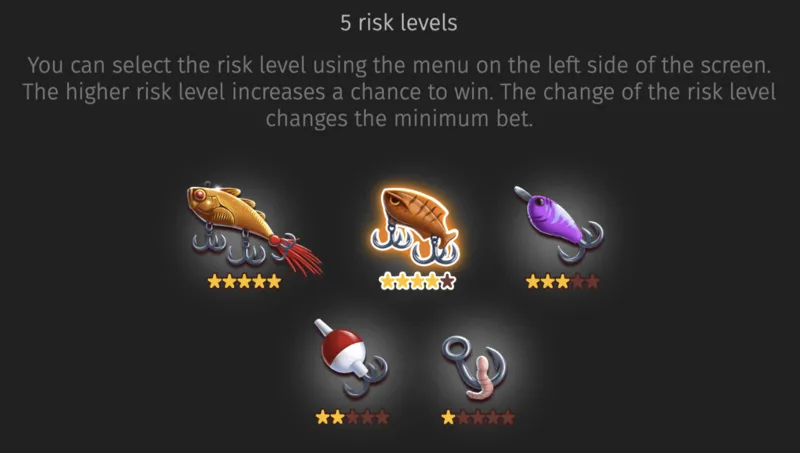
Choosing the right risk level is the most impactful strategic decision you make in Fishing Club 2 by BGaming. Since the RTP is virtually identical across all five levels, the choice comes down to matching your bankroll size and session goals to the appropriate volatility tier. Here is my framework for selecting a risk level based on over 500 casts of testing across all tiers.
Risk Level Recommendation Matrix
| Risk Level | RTP | Volatility | Recommended Bankroll | Playstyle | Best For |
|---|---|---|---|---|---|
| Level 1 | 97.16% | Very Low | 30-50x bet | Ultra-conservative | Beginners, small bankrolls, learning the game |
| Level 2 | 97.16% | Low | 50-80x bet | Conservative | Extended sessions, steady gameplay |
| Level 3 | 97.16% | Medium | 80-120x bet | Balanced | Most players, best risk/reward ratio |
| Level 4 | 97.16% | High | 120-200x bet | Aggressive | Experienced players, larger bankrolls |
| Level 5 | 97.16% | Very High | 200x+ bet | Ultra-aggressive | High rollers, chasing maximum multipliers |
Dynamic Risk Level Switching
One of the most effective Fishing Club 2 by BGaming strategies involves switching risk levels during a session based on your current bankroll position. Here is the approach I use:
- Start at risk level 2 or 3 to establish a baseline and get a feel for the session's variance pattern.
- If your bankroll grows by 50% or more, consider moving to a higher risk level. You are now playing with profits, which gives you a larger cushion to absorb volatility.
- If your bankroll drops by 30% or more, step down one risk level to preserve what remains. Chasing losses at higher risk levels is the fastest path to bust.
- Never jump more than one level at a time. Moving from level 1 to level 5 is reckless regardless of circumstances.
This dynamic approach allows you to capitalize on winning streaks while protecting against extended downswings — a core principle of effective Fishing Club 2 by BGaming bankroll management.
Bankroll Management for Fishing Club 2 by BGaming
Bankroll management is the single most important skill for Fishing Club 2 players. Even with a 97.16% RTP, poor bankroll discipline is the number one reason players leave sessions disappointed. The mathematics are unforgiving: if you bet too large relative to your bankroll, variance will deplete your funds before the RTP has a chance to work in your favour.
Setting a Session Budget
Before you even open Fishing Club 2 by BGaming, decide on a fixed amount you are prepared to lose. This is your session budget — the maximum amount you will deposit and wager during a single playing session. I recommend the following framework:
- Determine your total gambling budget for the week or month. This should be discretionary income you can afford to lose entirely.
- Divide it into session budgets. If your monthly budget is 200 EUR and you play 4 times per month, each session budget is 50 EUR.
- Never exceed your session budget. When it is gone, stop playing. Do not reload, do not chase losses, do not dip into next week's allocation.
- Set a win limit too. If you double your session budget, consider cashing out. Locking in profits is a discipline that separates strategic players from recreational ones.
Bet Sizing Relative to Bankroll
The relationship between your bet size and your session bankroll directly determines how many casts you can sustain before going bust. Here is my recommended bet sizing formula for Fishing Club 2 by BGaming:
| Risk Level | Max Bet as % of Bankroll | Example (50 EUR Bankroll) | Estimated Casts Before Bust |
|---|---|---|---|
| Level 1-2 | 2-3% | 1.00-1.50 EUR per cast | 80-150+ casts |
| Level 3 | 1-2% | 0.50-1.00 EUR per cast | 100-200+ casts |
| Level 4-5 | 0.5-1% | 0.25-0.50 EUR per cast | 150-300+ casts |
The inverse relationship is intentional: higher risk levels require smaller bets relative to your bankroll because the variance swings are larger. A risk level 5 session with 2% bet sizing will bust far more often than a risk level 1 session at the same percentage. The Fishing Club 2 by BGaming rewards patience and discipline.
The 50-Cast Rule
Through my testing of Fishing Club 2 by BGaming, I developed what I call the 50-cast rule: always structure your bankroll so that you can sustain at least 50 casts at your chosen bet size and risk level. Anything less than 50 casts does not give the RTP enough runway to influence your results. Fifty casts is the minimum; 100-200 casts is ideal. If your bankroll cannot support 50 casts at a given bet size, reduce the bet or lower the risk level.
Optimal Betting Strategies for Fishing Club 2 by BGaming

Based on 500+ casts across all five risk levels, I have identified three primary betting strategies for Fishing Club 2. Each has distinct advantages and trade-offs. No strategy can overcome the 2.84% house edge in the long run — that figure is mathematically fixed by BGaming's RNG — but the right approach can maximize entertainment value, control risk exposure, and improve your chances of ending a session in profit.
Strategy Comparison Table
| Strategy | Risk Level | Bet Sizing | Session Length | Win Potential | Bust Risk | Best For |
|---|---|---|---|---|---|---|
| Conservative | 1-2 | 1% of bankroll | Long (150+ casts) | Low-Medium | Very Low | Preservation, learning |
| Balanced | 2-3 | 1.5% of bankroll | Medium (80-150 casts) | Medium | Low-Medium | Most players |
| Aggressive | 4-5 | 0.5-1% of bankroll | Variable (50-200 casts) | High | Medium-High | Big win hunters |
Conservative Strategy: The Grinder
The conservative approach to Fishing Club 2 by BGaming prioritizes session longevity above all else. You play at risk levels 1 or 2 with bets capped at 1% of your session bankroll. With a 50 EUR bankroll, that means 0.50 EUR per cast. At this rate, you can sustain well over 100 casts even during a cold streak, giving the 97.16% RTP ample opportunity to manifest.
The downside is obvious: your maximum win per cast is limited because risk levels 1-2 have compressed multiplier distributions. You are unlikely to trigger Super Mega Win animations. But you are also unlikely to bust in 15 minutes. For players who enjoy the meditative quality of Fishing Club 2 by BGaming — the cast, the wait, the catch — this strategy maximizes playtime per euro spent.
Balanced Strategy: The Smart Player
This is the strategy I personally use for most Fishing Club 2 by BGaming sessions. Risk level 3 provides the optimal balance between volatility and multiplier potential. You bet 1-2% of your bankroll per cast, aiming for 80 to 150 casts per session. The multiplier distribution at level 3 includes meaningful x10-x50 catches without the extreme dry spells of levels 4-5.
The balanced strategy also incorporates dynamic risk switching. If my bankroll grows by 40-50%, I might move to risk level 4 for 10-20 casts to take a shot at higher multipliers. If it drops by 25%, I step down to level 2. This adaptive approach keeps sessions engaging while maintaining bankroll discipline.
Aggressive Strategy: The Big Fish Hunter
The aggressive strategy targets the highest possible multipliers in Fishing Club 2 by BGaming. You play primarily at risk levels 4 and 5, where the payout distribution is widest and the x3000 ceiling becomes the headline upside. However, the bet sizing must be conservative — 0.5% to 1% of your bankroll — to compensate for the dramatically increased variance.
This approach requires a larger starting bankroll (minimum 200x your bet size) and a high tolerance for losing streaks. You might go 30-40 casts without a meaningful win, then hit a single large multiplier that puts you well into profit. The emotional discipline required is substantial, which is why I only recommend this strategy for experienced Fishing Club 2 by BGaming players.
Fish Value Analysis: Understanding the Paytable
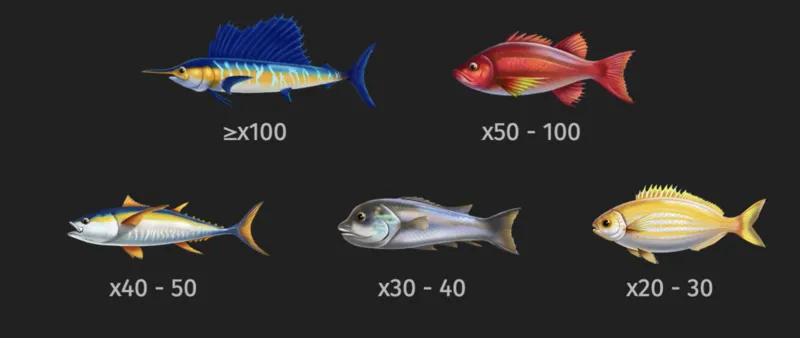
Every cast in Fishing Club 2 by BGaming catches exactly one fish, and each fish species carries a fixed multiplier. Unlike slot games with paylines, there is no concept of matching symbols or triggering combinations. The outcome is singular: one fish, one multiplier, one payout. Understanding the fish value distribution is essential for setting realistic expectations and choosing the right risk level.
Fish Tier Breakdown
The Fishing Club 2 by BGaming paytable can be divided into four distinct tiers based on multiplier value and catch probability:
| Tier | Fish Types | Multiplier Range | Catch Frequency | Strategic Relevance |
|---|---|---|---|---|
| Common | Small fish, empty catches | x0 – x1 | Very High | These are the noise. They erode your bankroll slowly. Accept them as the cost of playing. |
| Mid-Value | Medium fish species | x2 – x10 | Moderate | The workhorses. These catches sustain your bankroll and keep sessions alive. |
| High-Value | Large fish species | x10 – x50 | Low | Session-changers. One x30 or x50 catch can turn a losing session into a profitable one. |
| Ultra-Rare | Rare top-end outcomes | x50 – x3000 ceiling | Very Low | Dream catches. These trigger Mega Win or Super Mega Win animations and can deliver life-changing returns. |
Probability and Expected Value
A common misconception about Fishing Club 2 is that you can influence which fish you catch. You cannot. Fishing Club 2's certified RNG determines every outcome independently. The probability distribution shifts across risk levels, though. At higher risk levels, the chance of catching ultra-rare fish increases — but so does the chance of catching x0 (empty) fish. The mid-value tier shrinks as the distribution becomes more polarized.
From a pure expected value (EV) perspective, all risk levels in Fishing Club 2 by BGaming are essentially equivalent because the RTP is nearly identical. The difference is in the distribution of outcomes around that expected value. Risk level 1 gives you many small returns clustered near the mean. Risk level 5 gives you fewer but more extreme results, both positive and negative.
The strategic takeaway: do not choose a risk level based on which fish you want to catch. Choose it based on how much variance your bankroll and temperament can handle. The fish will come according to the probabilities — your job is to still be in the game when they do.

Autospin Strategy for Fishing Club 2 by BGaming
Fishing Club 2 includes an Autospins feature that automates casts for a predetermined number of rounds without manual input. Used correctly, autospin supports a disciplined strategy. Used carelessly, autospin accelerates bankroll depletion.
When to Use Autospin
- Low risk levels (1-2) with small bets: Autospin is most appropriate when you are grinding at low volatility. The smooth return profile at risk levels 1-2 means your bankroll is unlikely to swing dramatically between casts, making automated play relatively safe.
- Collecting data: If you want to test a specific risk level's variance profile, setting 50-100 autospins and reviewing the results gives you a data-driven view of the multiplier distribution.
- Demo mode practice: When playing Fishing Club 2 by BGaming in demo mode, autospin lets you rapidly sample different risk levels to understand their behaviour before committing real money.
When to Avoid Autospin
- High risk levels (4-5): At high volatility, your bankroll can swing dramatically within a few casts. Manual control allows you to pause, reassess, and adjust your bet size or risk level after significant swings.
- Without stop conditions: Never run autospin in Fishing Club 2 by BGaming without setting loss limits. If the feature allows stop conditions (stop on loss of X, stop after win of Y), always configure them.
- When emotionally compromised: If you are chasing losses or feeling frustrated, autospin removes the natural pause between casts that gives you time to make rational decisions.
Recommended Autospin Settings
If you choose to use autospin in Fishing Club 2 by BGaming, here are my recommended configurations:
- Number of spins: Set a maximum of 20-50 autospins at a time. Review your balance after each batch before starting another.
- Loss stop: Configure a stop-loss at 20-30% of your session bankroll. If your balance drops by this amount during autospin, the feature should pause so you can reassess.
- Win stop: Set a win stop at 50-100% of your starting session bankroll. Locking in significant gains automatically prevents the common mistake of giving back profits.
- Quick Spin: Enable Quick Spin alongside autospin to reduce animation time. This is purely a quality-of-life improvement and does not affect outcomes or RTP.
Common Mistakes to Avoid in Fishing Club 2 by BGaming

Based on 500+ casts of personal testing and feedback from players on casino forums, I have identified the seven most frequent strategic errors in Fishing Club 2. Avoiding these mistakes will not guarantee wins — nothing can — but will significantly improve your decision-making and bankroll longevity.
1. Playing Risk Level 5 with an Insufficient Bankroll
This is the single most common and most costly mistake. Risk level 5 in Fishing Club 2 by BGaming has extreme variance. You might go 30 or 40 casts without a meaningful return, and if your bankroll only covers 40-50 casts, you will bust before the big fish arrive. Always confirm you have at least 200x your bet size before playing at risk level 5. If you cannot meet that threshold, drop to a lower risk level.
2. Chasing Losses by Increasing Bet Size
The gambler's fallacy — the belief that a losing streak makes a win more likely — is mathematically false. Every cast in Fishing Club 2 by BGaming is independent. Doubling your bet after a loss does not increase your chances of catching a high-value fish. It merely increases the speed at which you deplete your bankroll. If you are losing, the correct response is to maintain or reduce your bet size, never to increase it.
3. Not Setting Session Budgets
Playing Fishing Club 2 by BGaming without a predetermined session budget is like driving without a fuel gauge. You have no way to know when to stop until you have already gone too far. Set a fixed session budget before you start, and stick to it regardless of what happens during play.
4. Treating Fishing Club 2 as Skill-Based
Fishing Club 2 uses a certified RNG audited under BGaming's Curacao licence. There is no skill involved in the outcome of individual casts. You cannot time your casts, predict which fish will appear, or influence the RNG in any way. Strategy in Fishing Club 2 is entirely about bankroll management, risk level selection, and bet sizing — not about catching technique or pattern recognition.
5. Choosing Risk Levels for the Wrong Reason
Some players mistakenly believe higher risk levels have significantly better or worse RTP. BGaming currently publishes Fishing Club 2 at 97.16% RTP, so the choice between risk levels should be based on volatility tolerance and bankroll size, not on a perceived RTP advantage.
6. Using Autospin Without Stop Conditions
Running autospin in Fishing Club 2 by BGaming without loss limits is one of the fastest ways to empty your bankroll. Autospin removes the natural pause between casts that allows for rational decision-making. Always set stop-loss and stop-win conditions when using the autospin feature.
7. Playing While Emotionally Compromised
Whether you are frustrated from a losing streak or euphoric from a big win, emotional states impair strategic thinking. Fishing Club 2's RNG does not adjust to your emotional state — outcomes are identically distributed regardless. If you notice yourself making impulsive decisions (increasing bets, switching to risk level 5, ignoring your budget), take a break. Come back when you can think clearly.
Fishing Club 2 by BGaming vs. Similar Casino Games
This comparison uses published RTP data from BGaming, Pragmatic Play, and RTG as of Q1 2026. Fishing Club 2's positioning against the two most popular competitors in the fishing casino genre breaks down as follows.
| Feature | Fishing Club 2 | Big Bass Bonanza | Fish Catch (RTG) |
|---|---|---|---|
| Provider | BGaming | Pragmatic Play | RTG (RealTime Gaming) |
| RTP | 97.16% | 96.71% | ~95.5% |
| House Edge | 2.84% | 3.29% | ~4.5% |
| Volatility Control | 5 risk levels (player-controlled) | Fixed (high) | Fixed (medium-high) |
| Bonus Rounds | Fishing Net, TNT | Free spins, multiplier fisherman | Multiplayer shooting |
| Max Multiplier | x3000 | x2100+ | Varies by target |
| Strategic Depth | High (risk/bankroll management) | Low (fixed volatility) | Medium (target selection) |
Fishing Club 2 holds a clear edge in RTP (97.16%) and player-controlled volatility (5 tiers vs. fixed). BGaming's title also includes Fishing Net and TNT bonus-buy options, while the 2.84% house edge is lower than those rivals. For mathematically minded players who prioritize RTP and bankroll control, Fishing Club 2 is the stronger pick.
Big Bass Bonanza still leans harder into slot-style bonus spectacle, making it better suited for players who prioritize entertainment over mathematical optimisation. Fish Catch by RTG takes a different approach entirely with multiplayer shooting mechanics, but its lower RTP makes it less favourable from a pure strategy perspective.
Where to Apply These Fishing Club 2 by BGaming Strategies
Fishing Club 2 is available at licensed online casinos that carry BGaming titles. I recommend choosing an operator with verified RNG certification, withdrawal processing under 48 hours, and responsible gambling tools compliant with Curacao or MGA standards. Below is a partner where you can play Fishing Club 2 for real money or practice in free demo mode.
Play Fishing Club 2 for Real Money
- Licensed and regulated online casino
- Full Fishing Club 2 by BGaming with all 5 risk levels
- Free demo mode available for strategy testing
- Fast deposits and withdrawals
- Responsible gambling tools and self-exclusion options
Strategy Guide Update History
Optimistic Strategy Outlook
Fishing Club 2 by BGaming offers a refreshingly practical strategy landscape because its main variables are visible and easy to organise. The 97.16% RTP, 2.84% house edge, x3000 maximum multiplier, five risk levels, Fishing Net and TNT bonus-buy options, and autospin settings all help players separate entertainment choices from false prediction systems. That clarity is encouraging: a conservative player can stay around risk levels 1-2, a balanced player can build sessions around level 3, and a high-variance player can reserve levels 4-5 for a small, pre-planned part of the budget.
The optimistic approach is to treat each cast as part of a controlled sample, not as a targetable fish hunt. A session with 50-100x the chosen bet, fixed stop-loss rules, and risk-level changes only after profit can feel measured and enjoyable. The RNG still decides every catch, but the player controls the pace, exposure, and moment to stop. That is where Fishing Club 2 strategy becomes genuinely useful.
Fishing Club 2 by BGaming Strategy FAQ
The best risk level depends on your bankroll size and playstyle. For bankrolls under 50x your bet, stick to risk levels 1-2 for lower variance and longer sessions. For bankrolls of 100x or more, risk level 3 offers the best balance between volatility and multiplier potential for most players. Risk levels 4-5 are best reserved for bankrolls exceeding 200x your bet. The RTP remains nearly identical across all levels (97.16%), so the choice is purely about variance tolerance and session goals.
The 97.16% RTP means the house edge is only 2.84%, which is significantly lower than the industry average of approximately 4%. Strategically, this means your bankroll erodes more slowly over time, giving you more casts per session and more opportunities to hit high-value outcomes. The favourable RTP supports longer sessions and makes conservative bankroll management even more effective. Over 200 casts, you save roughly 2.30 EUR per 100 EUR wagered compared to an average slot.
A solid rule of thumb is to have at least 50-100x your chosen bet size as your session bankroll. For risk levels 1-2, 50x is sufficient due to lower variance — a 50 EUR bankroll at 1 EUR per cast works well. For risk level 3, aim for 80-120x your bet. For risk levels 4-5, you need 150-200x or more to handle the extreme volatility swings. Never bet more than 2-3% of your total session bankroll on a single cast, and always set a hard loss limit before you begin playing.
Autospin is a useful tool when applied strategically. It works best at low risk levels (1-2) with small, consistent bets where the variance is manageable. Always set stop conditions: a loss limit at 20-30% of your session bankroll and a win limit at 50-100% of your starting balance. Avoid autospin at risk levels 4-5, where manual control allows you to react to large swings. Never use autospin without predefined stop limits — it removes the natural decision-making pause between casts.
No, Fishing Club 2 by BGaming uses a certified Random Number Generator (RNG), which means every cast produces a mathematically independent outcome. You cannot target, predict, or influence a specific catch. However, higher risk levels shift the probability distribution, increasing your exposure to high-value outcomes while also increasing the frequency of empty catches.
The most frequent strategic errors include: playing risk level 5 with an insufficient bankroll (under 200x bet), chasing losses by increasing bet sizes after a losing streak, not setting session budgets before playing, treating the game as skill-based rather than probability-based, using autospin without stop-loss conditions, and playing while emotionally compromised (frustrated or euphoric). Disciplined bankroll management is the single most impactful strategy you can adopt for Fishing Club 2 by BGaming.
Fishing Club 2 by BGaming offers a superior RTP of 97.16% compared to competitors like Big Bass Bonanza (96.71%) and Fish Catch by RTG (approximately 95.5%). Its five-tier risk system provides strong strategic depth, while Fishing Net and TNT add two bonus-buy paths. The lower house edge and bankroll management options make it a strong choice for strategy-focused players who prioritize mathematical advantage.